Productive Robotics
Weld Monitoring Dashboard
Built a real-time weld monitoring dashboard streaming arc current, arc voltage, and tool-tip position with synchronized CSV data capture — used for weld quality diagnostics and process optimization.
Developed a real-time streaming dashboard with dual-axis weld plotting (arc current and arc voltage on a shared time axis) and a separate tool-center-point position chart computed from forward kinematics, enabling direct correlation between weld parameter excursions and physical position on the workpiece. Rolling statistics surface averages, peaks, torch duty cycle, and data rate. Interactive point selection lets operators click on chart points for post-weld analysis.
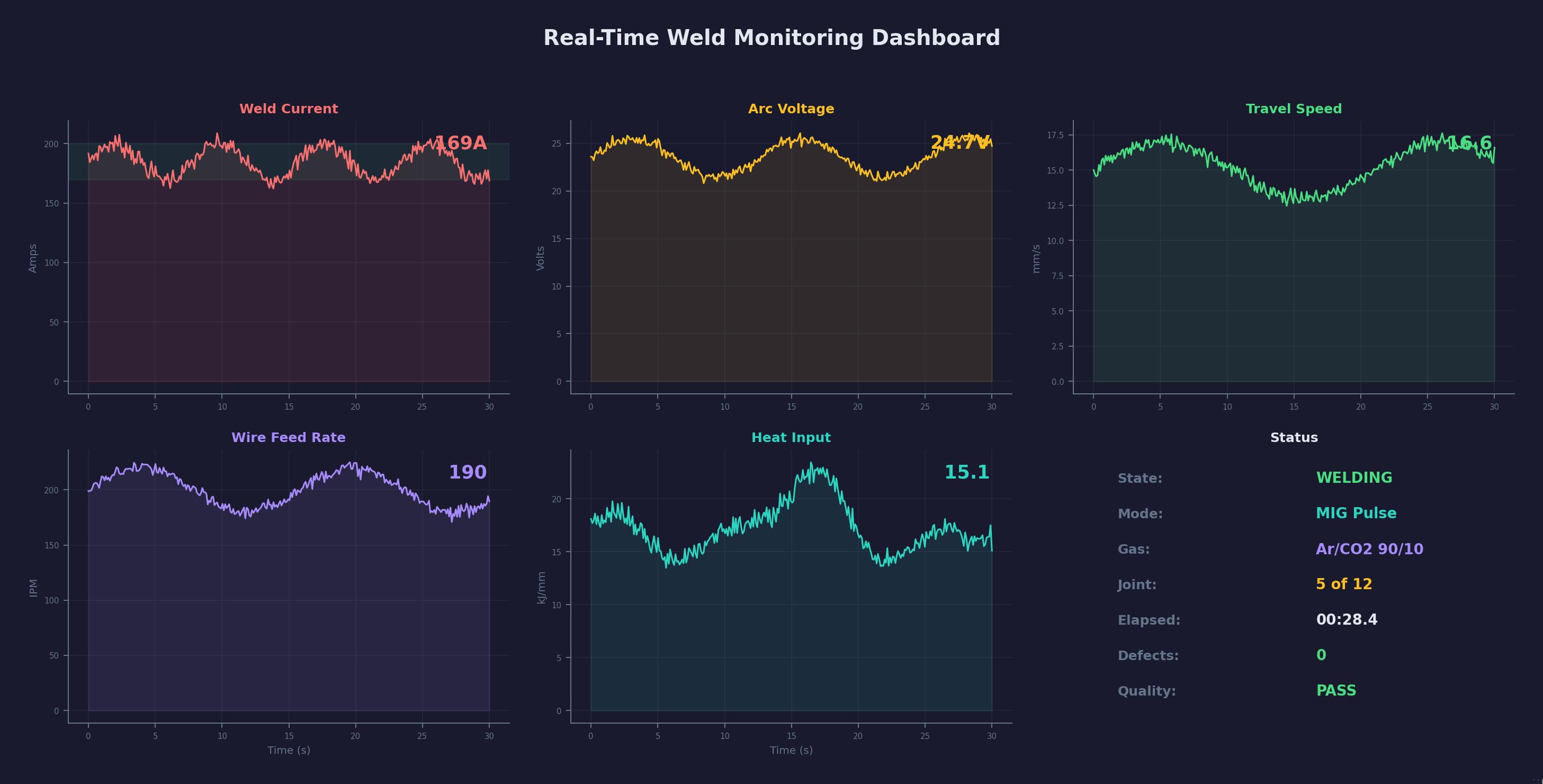
Tuned the input telemetry rate from the welder for responsive data capture. Display updates are throttled for smooth rendering while the underlying capture pipeline records every sample.
Built a CSV recording system capturing timestamped arc parameters, tool-tip position, torch state, and gas state — suitable for post-weld analysis against welding code requirements (industry standards such as AWS D1.1 and ISO 3834 generally require documented weld parameters as part of process compliance documentation). Also built supporting simulators and a headless background recorder for development and offline analysis.